A bank can reconstruct a transaction.
It can show where the money came from, where it went, when it moved, and who authorized it. If the transaction is disputed months later, the institution does not rely on the memory of everyone who touched it. The record carries the sequence.
Relationship decisions rarely receive the same discipline.
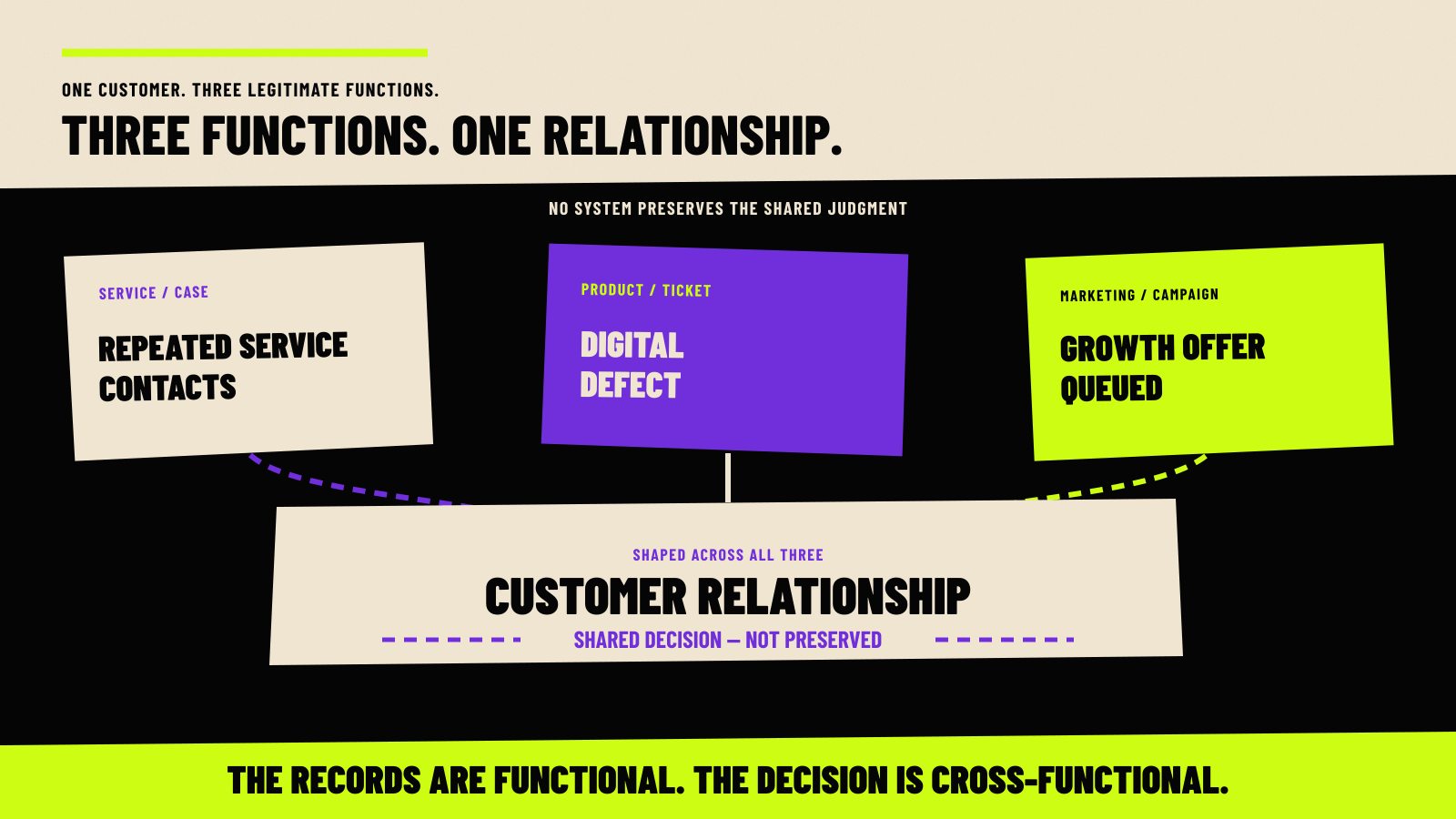
Three teams. Three legitimate actions.
Consider a hypothetical customer whose activity inside the bank appears strong. Recurring inflows, regular payments, and everyday account use suggest that the bank is central to the financial activity it can observe.
The bank can also see weak Relationship Health evidence, repeated service contacts involving the same digital failure, and a growth offer already waiting in a marketing queue.
Each function has a legitimate job to do.
Service needs to resolve a recurring customer problem. Product needs to investigate and repair a defect. Marketing has a valid commercial reason to send an offer based on observed behavior and eligibility.
None of those actions is inherently wrong. Each team can follow its process, meet its objective, and preserve a clean record of the work. Service keeps the case. Product keeps the ticket. Marketing keeps the campaign record.
What the bank may not keep is the decision that connects them.
The digital failure may have contributed to the weak relationship evidence—or the signals may simply have appeared together. The institution still has to decide whether the offer should proceed while recovery is underway, who can authorize a temporary pause, and what the outcome would allow it to conclude.
No functional record answers the governing question: What should the bank do across all three responses—and why?
Every function kept a record. The bank lost the decision.
The dashboard did its job
This is not an argument against dashboards or customer data. The dashboard correctly made a concerning condition visible.
It still could not see the customer’s external balances, competing financial relationships, motive, or intent. Strong activity inside one bank does not prove loyalty. Weak Relationship Health does not prove that a digital defect caused it. Seeing the signals together does not authorize a retention treatment, a product intervention, or a growth offer.
The condition has earned a question—not a conclusion.
Banking already recognizes a version of this distinction in model risk. Revised interagency guidance issued in 2026 warns that even a fundamentally sound model can create significant risk when it is misapplied or misused. It calls for effective challenge from people with the expertise, independence, and influence to produce change. Its documentation provisions support continuity and track recommendations, responses, and exceptions.
The guidance applies to quantitative models, not relationship decisions, and it does not prescribe the artifact proposed here. But the design principle transfers: making an output visible is not the same as governing the judgment built around it.
The reasoning behind a decision should survive the decision itself.
A ledger for the institution’s judgment
That missing record is what I mean by a Relationship Ledger.
It is not a ledger of the customer. Banks already preserve extensive records of customer activity. It is a lightweight record of the institution’s judgment about a material relationship question.
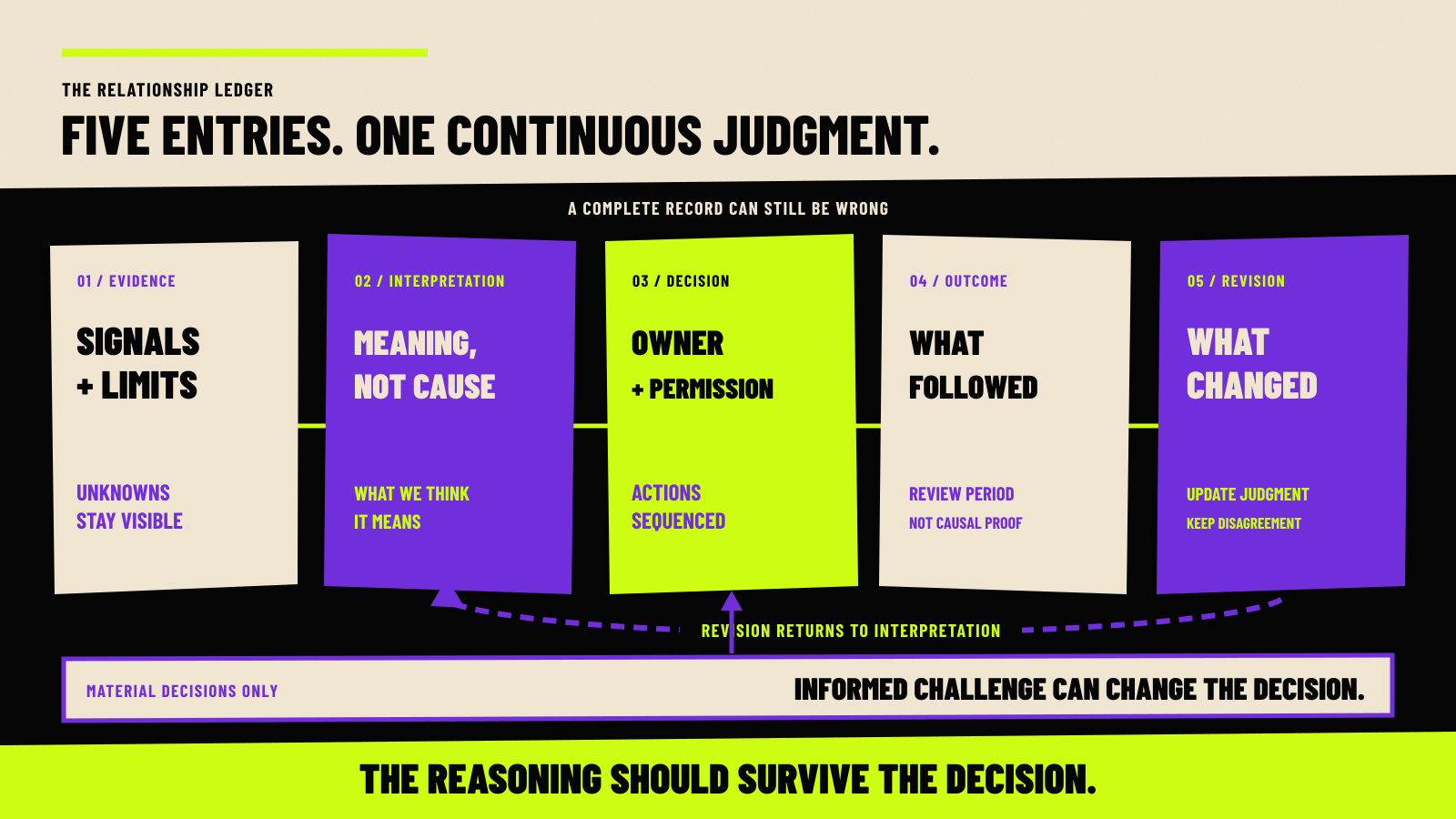
For this case, it might contain five entries:
- Evidence: Strong activity inside the bank; weak Relationship Health evidence; a recurring digital failure; the customer’s external wallet and motive remain unknown.
- Interpretation: The failure may be contributing to relationship weakness, but the available evidence does not establish causation.
- Decision: A named owner authorizes repair and temporarily pauses the queued offer for review—not because Marketing’s objective is illegitimate, but because the bank has chosen a sequence across competing actions.
- Outcome: The defect is resolved. During the agreed review period, the customer’s observed behavior remains roughly unchanged.
- Revision: The service failure was real and worth fixing. Its effect on the broader relationship remains unknown; the outcome does not support a new loyalty claim.
A CRM note, service case, product ticket, and campaign record all remain useful. The Relationship Ledger does not replace them or require a new software category. It connects their partial truths when the decision is consequential enough that the institution may later need to explain, challenge, or revise its judgment.
A record can be complete while the judgment inside it remains insulated from challenge. If an informed objection cannot reach someone with the authority to reconsider the interpretation or response, the institution has preserved an archive—not effective governance.
Nor should every customer interaction receive this treatment. The ledger belongs where a material relationship question crosses functional boundaries, competing actions need to be sequenced, or the institution may later need to explain what it believed and why it acted.
The point is not more documentation. It is continuity of judgment.
A complete record can still preserve a bad decision
A terrible decision can be documented perfectly.
A Relationship Ledger cannot make missing evidence complete, manufacture sound judgment, or prove that one action caused a later outcome. If authority is absent or incentives conflict—Marketing is measured on conversion while a relationship decision calls for restraint—the ledger can expose the collision. It cannot resolve it by itself.
It becomes governance theater when teams complete the fields as a formality but never allow an outcome or a credible challenge to revise the original interpretation. It becomes administrative overhead when every routine interaction demands the same ceremony as a consequential cross-functional decision.
Its claim is narrower. When a material relationship decision crosses functional systems, the institution should be able to reconstruct what it believed, who authorized the response, what happened, and what it learned afterward.
That makes weak assumptions visible. It preserves disagreement. It prevents a favorable metric from being recruited later as proof of a story the evidence never established.
The dashboard preserves the signal. Each team preserves its work. The Relationship Ledger preserves the decision between them.
Preserving the decision does not make the inquiry defensible. The institution still has to investigate the condition without assuming its cause. That is the next problem.
SOURCE LAYER
Provenance & references
Historical publication provenance: LinkedIn edition ↗.
- Board of Governors of the Federal Reserve System, OCC, and FDIC — Supervisory Guidance on Model Risk Management (SR 26-2, 2026) ↗ — Used as a bounded analogy for output visibility versus governed judgment. The guidance applies to quantitative models, not relationship decisions, and does not prescribe the Relationship Ledger.
- OCC — Model Risk Management: Revised Guidance (OCC Bulletin 2026-13, 2026) ↗ — Confirms the 2026 interagency replacement of the 2011 model-risk framework. It does not validate the Relationship Ledger.