A customer calls her bank for help, and the person on the phone is empathetic and thorough. Together they agree a plan, and the call ends. It would be easy for everyone to assume the problem is now being handled. But the plan depends on actions by both the bank and the customer. Some need to happen during the call; others come later. From the customer’s side, it may be hard to tell whether the bank has completed its part.
A journey map can show the experience from her side: a helpful conversation, a long silence, then a bad surprise. A service blueprint helps us follow the work needed to make the plan happen. What needed to be done, by whom, and when?
What happened
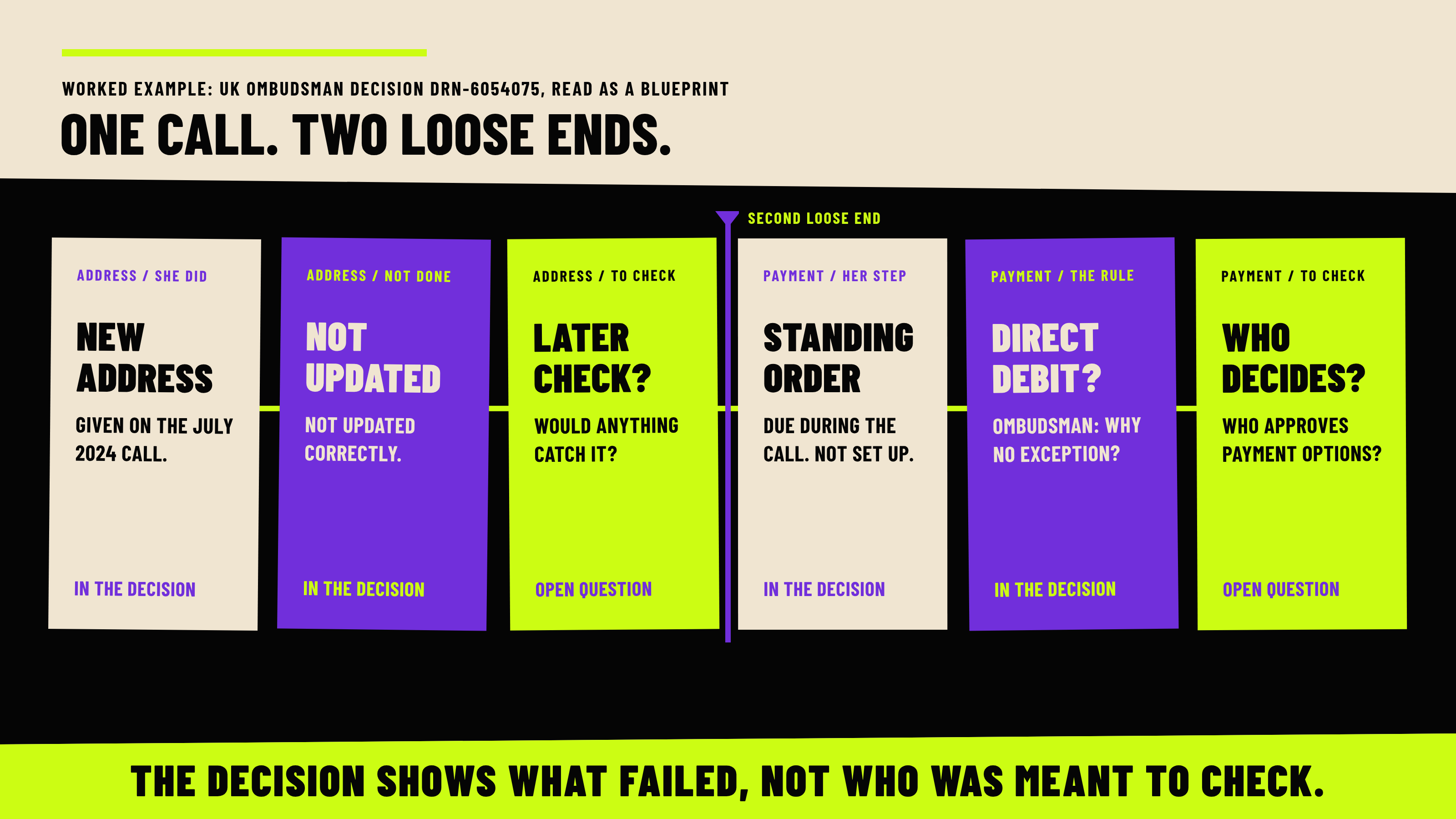
The case comes from a UK Financial Ombudsman Service decision about Santander. A customer had fallen behind on her credit card. In July 2024 she called, explained that she had medical conditions that affected her memory, and agreed to a 15-month payment plan. On the same call she gave Santander her new address.
The address wasn’t updated. The plan relied on a standing order (a regular payment) that she had to set up herself, and it wasn’t set up before the call ended. So the payments didn’t arrive, and the letters about her missed payments went to the wrong address. She found out in January 2025, when a debt collector told her the account had defaulted. The ombudsman upheld her complaint. Santander was told to remove the default and the interest and charges added since July 2024, and to pay her £300 on top of the £200 it had already paid for the address error.
Looking behind the call
A service blueprint draws the steps the customer sees and takes, and then, underneath, the work she never sees but depends on. Lynn Shostack described it in Harvard Business Review in 1984, opening with a failure that will sound familiar: “A customer service representative says he’ll get back to you and doesn’t.”
That makes the handoffs visible. A handoff is any point where work passes from one person, team or system to another, or from the bank to the customer. A conversation can be helpful and still leave a handoff that doesn’t happen.
Two pieces of unfinished work
Follow the two pieces of work the plan depended on.
The first was the address. Updating an address is one job: the change has to be recorded so that later letters go to the right place. The ombudsman counted the failure as the agent’s mistake: the address wasn’t updated correctly. What the decision doesn’t say is whether anything after the call would normally catch a change like that, or why nothing did.
The second was the payment. The plan depended on a step she had to take herself, and she had told the bank she loses track of important things. The ombudsman said the agent should have made sure the standing order was set up before the call ended, and asked why Santander couldn’t have made an exception and arranged a direct debit (where the bank collects the payment automatically) instead. That’s a different kind of job. Setting up a payment is one task; deciding which payment arrangements staff are allowed to offer is another, and the decision doesn’t say who makes that call.
For each piece of work, a blueprint asks the same few questions. What needed to happen, and what had to happen first? Who does it, and who can approve a different approach? When should it be done, and how would anyone know it was?
The public decision answers some of these and not others. It tells us what failed. It doesn’t tell us who, if anyone, was supposed to check. That difference matters in practice. If someone was responsible for a check, you need to find them and learn why it didn’t work. If nobody was ever given the job, someone has to decide who should have it. Until you know which is true, the honest answer is “we don’t know yet.”
One caution comes from the designer George Sheldrake: real services repeat and branch, and a tidy diagram can hide that. In his words, “The blueprint looks complete, the service isn’t.” This call had two branches. Many have more.
Where to start
You don’t need a workshop to begin. Pick one customer case your bank already knows well, such as a complaint. Write down what needed to happen during that conversation and afterward. Then mark which of those you can confirm happened, and which you would still have to check.
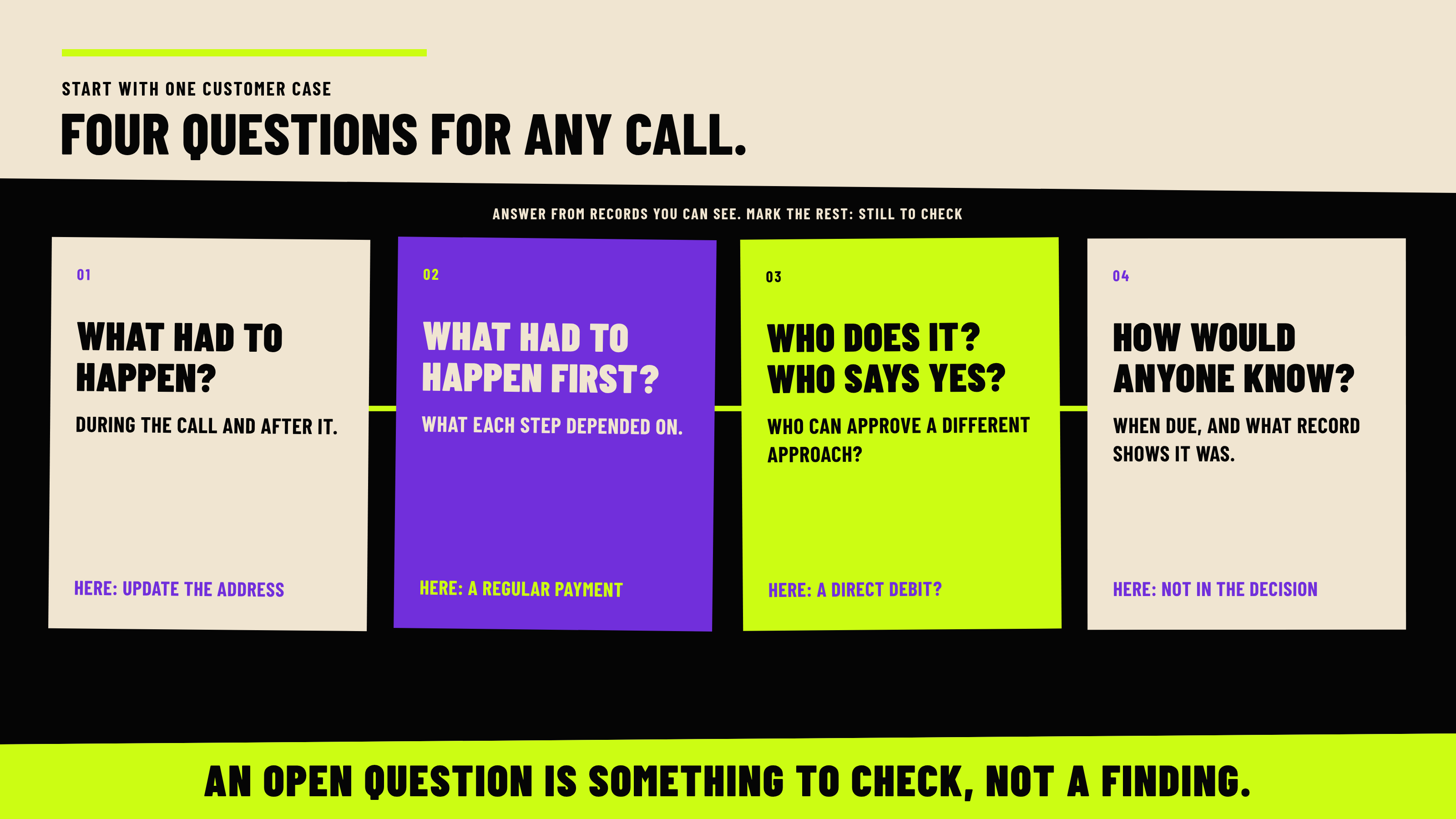
The worksheet has the full version, with the Santander case filled in.
What this case can and can’t show
This is a reading of a public decision. It isn’t a reconstruction of Santander’s internal process, and it isn’t a test of the method. And finding a gap is never a reason to delay what a customer is already owed.
This piece follows my previous article. The next one takes up the harder question: what should happen while a gap like this is still open, who decides, and for how long.
A call can be over while the service is still unfinished.
SOURCE LAYER
Provenance & references
- Financial Ombudsman Service — final decision DRN-6054075, complaint against Santander UK Plc, ombudsman Paul Cooper (provisional decision 25 November 2025; the customer was asked to accept or reject before 2 February 2026) ↗ — It documents this complaint and the ombudsman's reasoning, not Santander's internal process, and doesn't say whether the remedy was carried out.
- G. Lynn Shostack — Designing Services That Deliver (Harvard Business Review, January 1984) ↗ — The quote is from the opening paragraph.
- George Sheldrake — Design bias in 'service blueprints' (georgesheldrake.com, 8 May 2025) ↗
- Mary Jo Bitner, Amy L. Ostrom, and Felicia N. Morgan — Service Blueprinting: A Practical Technique for Service Innovation (California Management Review 50/3, Spring 2008, pp. 66–94) ↗ — Further reading on the method. It sets out the customer, frontline, backstage and support layers and the line of visibility between what customers see and the work behind it (p. 72).